
Sometimes It's the Invisible Fights Too?
I love a good march, but I love solidarity more.

So, we’re all trying to figure out how to respond right now, right? Trump has, so far, gotten going doing on paper what he said he was going to do. Lots of executive orders that might and might not be legal, but will probably be passed along because the courts don’t actually give a shit about what’s legal. No surprises, really. The law is for the powerful, not us.
But everyday folks are responding differently. Last time, it seemed like everyone was pouring into the streets to show the strength of the resistance. 3 or 4 million people (depending on who you ask) came out for the Women’s March a few days after Trump was inaugurated. We protested the Muslim Ban. We protested for immigrant protections. It seemed like every weekend, there was a crowd to join, sharing signs and chants and good feelings. People were reassured by being around like-minded people, so – at least around here – they drove from all over Michigan to come to places like Ann Arbor or Detroit or Grand Rapids.
I’ve been reading all kinds of pontification about what it means that we haven’t seen this same kind of large-scale protest movement this time around. There’s a lot of talk about people being exhausted, about people feeling defeated, and shit like that. And sure, folks are tired, but they’re always tired. So why aren’t we seeing a mass movement popping up in the streets?
I mean, there’s a few really simple possibilities.
For one, it’s fucking cold. People didn’t show up to any mass marches because it was deadly. On the day of the Women’s March in 2017, it was 58 degrees in Southeast Michigan. That’s not a sign of weak protestors. It’s not fair-weather folks (well, maybe a little of that). It’s people who aren’t trying to hobble themselves for the long fight ahead by getting sick.
Also, it turns out, getting together with people who already agree with you and hollering about what you collectively agree on didn’t turn out to make much difference. I mean, it didn’t make zero difference. There’s a feeling of possibility that gets built up by coming together with other folks and seeing that you’re not alone. But it didn’t stop people from getting harassed, hurt, detained, deported, evicted, etc.
And centralizing all the actions in a few big towns made it seem like those were the only places where people were into fighting back. Instead of having a gathering of even a few dozen folks in small towns, focused on how they might build power in those little local scenes, good people skipped town for the cool kids’ parties. Again. I get it. Feeling like there are a lot of people on the page with you helps during the dark times.
But – and maybe I’m being overly-optimistic here – another reason we might not be seeing the giant movement marches this time around is that people have learned that going to feel-good events mostly only helps the people at those events feel better. If we want to defend ourselves and our communities from the fascists coming in this time around, we have to focus on actually doing things.
And a lot of those things are going to have to be underground.
Like, sure, I’m glad that my local Sheriff’s office has doubled down on the sanctuary policies adopted by her predecessor last time around. That’s an important public statement. But it will arguably be more important for the real work to be invisible, done by people without talking about it. The people who are going to form networks so neighbors and family members know when ICE is around. The people who pick each other’s kids up from school when it’s not safe for undocumented parents to do it themselves. The legal aid workers helping people prepare power of attorney documents for child care in case of a detention or deportation. The love. The showing up with food. The showing up.
None of that is going to be seen on the news, but that doesn’t mean it isn’t happening and that it isn’t making a difference, that it isn’t building massive powerful potential. Is it going to stop Trump and his people? No, not right at the moment. But it will gum things up for them, and it will (re)teach us how to go to ground and fight for each other. To do it on the day by day by day, not on one sunny afternoon in a town we don’t mind visiting anyway before we pick up some tasty take out and go home to watch Netflix (no joke: that’s what we did on Women’s March day).
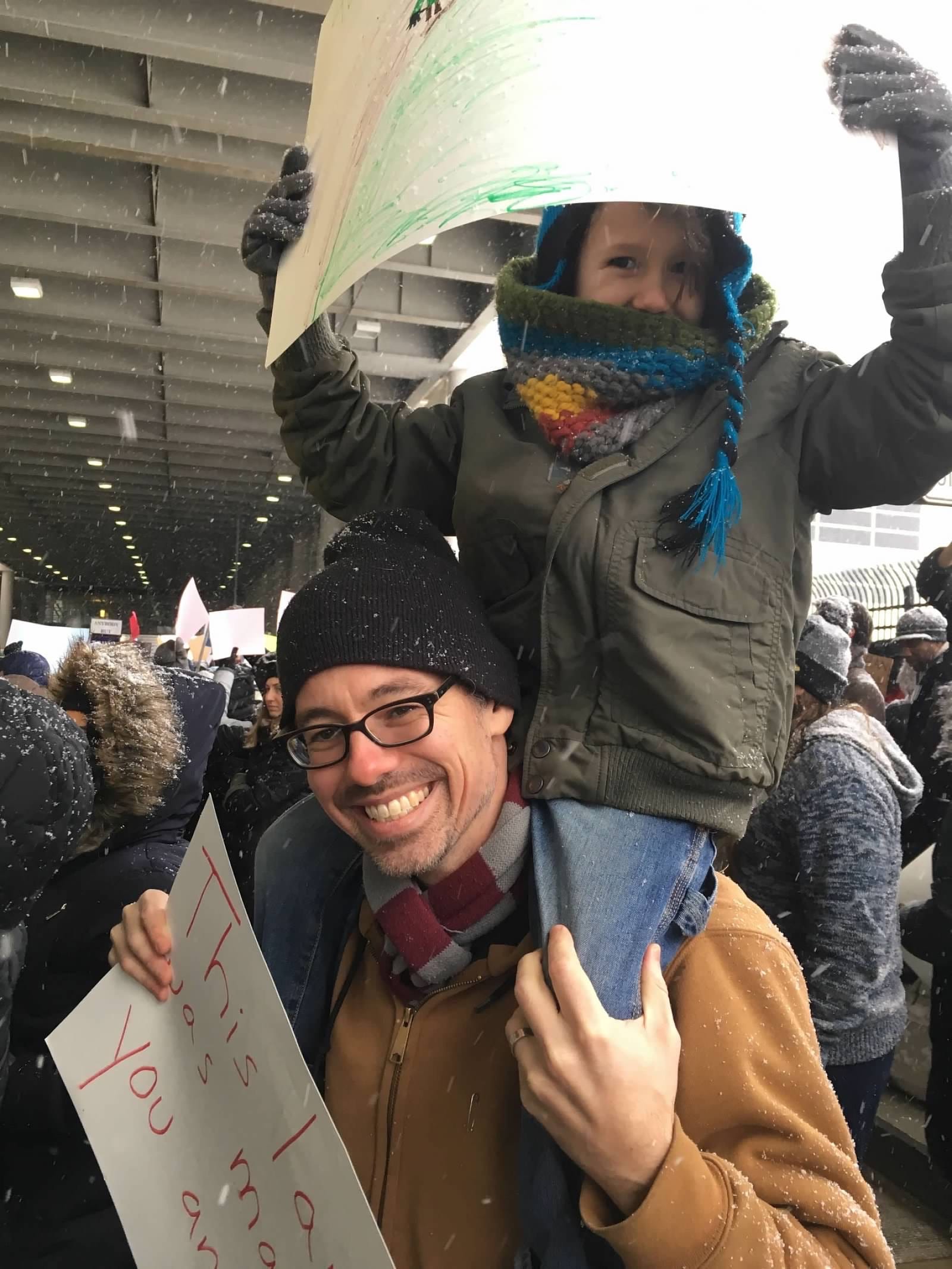
Of course, that isn’t to say that there won’t be a place for large-scale and visible movements. But they might be most effective when they’re directly tied to things that are local - things that we are actually trying to get done, not just saying “No!” to. We did see some of that last time too, especially when moments like the “Muslim Ban” came along, and folks got up and did some serious visible mass action. I remember standing at Detroit Metro in the snow with my kids and a huge crowd of people, shutting things down in support of the handful of travelers detained inside. That was tied to a local problem caused by Trump’s policies and we were fighting for our people, against decisions being made by people who lived and worked near us.
We weren’t voicing displeasure in the abstract. We were demanding different actions right at that moment, targeting people who could hear us, who had to live with us.
So that’s what I’m thinking about this week – the ways that I can start to build up not a resistance or whatever self-congratulatory shit that people wanted to tag themselves with last time, but more like . . . I don’t know . . . community? Solidarity? Something we don’t have a catch-all name for yet?
And I know that I’ve mentioned these poems a few times before on this Substack, but Martín Espada’s writing keeps coming up in conversations I’m having with students who are feeling helpless and wheel-spinny, so I’m gonna do it again!
I always start with talk about hope, and then we look at “Imagine the Angels of Bread,” where Martín writes:
If the abolition of slave-manacles
began as a vision of hands without manacles,
then this is the year;
if the shutdown of extermination camps
began as imagination of a land
without barbed wire or the crematorium,
then this is the year;
if every rebellion begins with the idea
that conquerors on horseback
are not many-legged gods, that they too drown
if plunged in the river,
then this is the year.
And isn’t that just the truth? That – while we’re struggling along together – one of the things we have to do is imagine the landscape we’re living in changing? That means coming up with new ideas for ourselves and each other.
But, as a good Marxist, I don’t think we’re going to pull these ideas of a new world out of the clouds, so I always try to balance that out with some talk about what’s already in the works - the material realities that we can draw on to help spark the new imagination.
Again, Martín has his eyes on that prize too in his “Not for Him the Fiery Lake of the False Prophet,” where he tells the story of an immigrant man attacked in a hate crime inspired by Trump, but saved and nursed back to health by construction workers and paramedics and nurses – people who are invisibly doing what they do, despite the seemingly-insurmountable opposition. And that world of good everyday people helping out the immigrant man - that world that already exists - is the hell Martín relegates Trump to:
For him, Hell is a country where the man in a hard hat
paving the road to JFK station sees Guillermo and dials 911;
Hell is a country where EMTs kneel to wrap a blanket around
the shivering shoulders of Guillermo and wipe his face clean;
Hell is a country where the nurse at the emergency room
hangs a morphine drip for Guillermo, so he can go back to sleep.
Two thousand miles away, someone leaves a trail of water bottles
in the desert for the border crossing of the next Guillermo.
That’s solidarity, invisible except to the people who need to see it. But it might build a power that we can’t quite imagine yet, sort of in the way that people hope that those feel-good marches do. It makes it possible to see that you’re not alone and that you can do things, not just say “no!” That’s where Martín leaves us – with a charge of an army of people who have figured out that they’re in it together and that it terrifies the people who are coming to do us harm:
We smuggle ourselves across the border of a demagogue’s dreams:
Confederate generals on horseback tumble one by one into
the fiery lake of false prophets; into the fiery lake crumbles
the demolished Wall. Thousands stand, sledgehammers in hand,
to await the bullhorns and handcuffs, await the trembling revolvers.
In the full moon of the flashlight, every face interrogates the interrogator.
In the full moon of the flashlight, every face is the face of Guillermo.
So. What can you do this week? It doesn’t have to be large-scale. It doesn’t have to be visible. It doesn’t have to single-handedly stop Trump and the onslaught of fascism in its tracks. It just has to help someone. It has to show love. It has to show patience. It has to build up the idea that, if we want something to be better, we will have to do it ourselves - to, for, and with each other.
Each one of us should be able to make a difference… Even in a small way. Just reach out and help someone… Show a little love and understanding 💕